Does Your Investment Property Still Measure Up?The purpose of this page is to give a friendly reminder to people who own investment property. You probably made a good investment when you first bought your investment property. But have you owned it too long? Depending on how long you’ve held your property, it might not be a good investment anymore. We didn’t say not a good property; we said not a good investment. Read on to find a simple way to determine if your property is still measuring up. You may be in for a surprise! First, let’s quickly review the four financial benefits of owning investment real estate:
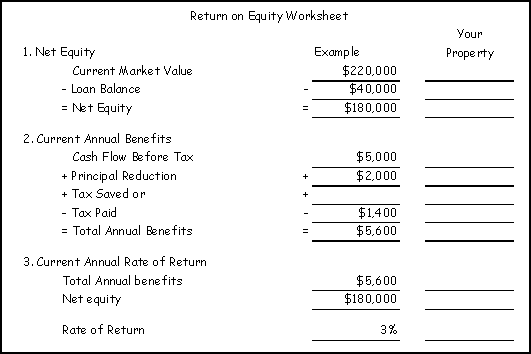
These four benefits are powerful! You earn tax-sheltered cash flow, your tenants buy you the building, you get to tell the IRS you’re losing money, and all-the-while, the property goes up in value. So why are we challenging you to reconsider whether your property is still a good investment? Simple! Your “return on equity” is probably low — and getting lower by the year! Let us show you an example. Don’t get all tangled up in the numbers. Just concentrate on the big picture and how it applies to you. Return on Equity Drops from 18 to 3 Percent Assume you bought a rental house 10 years ago for $70,000. You invested $10,000 and borrowed the rest. Your goal is to retire in another 15 years and use the rental house to provide retirement income. (A great plan!) So, how good was your investment 16 years ago? Let’s total your benefits. Assume the cash flow, principal reduction and tax savings added up to $1,800 that first year. You were earning 18 percent ($1,800 divided by $10,000) on your investment. Not bad. Plus the rental house was appreciating. Fast-forward 10 years to the present. Let’s assume the following: Your yearly cash flow has increased to $5,000 and the principal reduction is $2,000; a total of $7,000 — just from the first two benefits! In addition, let’s assume the net value of your rental house has appreciated over the years so it’s now worth $220,000 and your loan has been paid down to $40,000. However, because you’ve owned the property so long, the depreciation deductions (assume they’re $3,000) are no longer enough to shelter the $7,000 of cash flow and principal reduction. That leaves $4,000 of unsheltered (taxable) income. Instead of saving tax, you have to pay tax. If you're in a 35-percent bracket, (combined federal and state), you pay $1,400 tax. So, your benefits from the rental house now look like this: $5,000 cash flow, plus $2,000 principal reduction, minus $1,400 tax paid. A total of $5,600. This is all summarized on the “Return on Equity Worksheet” below. (The blanks in the right column are for you to use on your own property.) A more detailed form is available at www.kenmillerassociates.com/InvestmentWorksheet.xls
If you measure the $5,600 against your original $10,000 investment: that’s a 56 percent return. But that’s where most people go wrong! Your Original Investment Has Nothing to Do with Today’s Rate of Return! Your investment is not the amount you originally invested years ago. You’ve got way more than $10,000 “tied up” today! Your investment is the amount you could get out of the property if you sold it today. That’s called your “net equity.” Over the past 10 years, your property has increased in value and your mortgage has been paid down. The current difference between the property’s net value and your mortgage balance is $180,000. In other words, if you sold the property today, you could walk away with $180,000. However, if you keep the property, in effect you’re re-investing the $180,000 into the property. Now, how does your investment look? Not so good. You’re earning $5,600 in benefits on an $180,000 investment — that’s only 3 percent! What if a REALTOR called you up and said, “I’ve got a great real estate investment for you. You’ll earn 3 percent.” You’d hang up on them! Well, you already own it! If you wouldn’t buy a property like that, why would you continue to own it? What if you did this instead? Use your $180,000 equity as the down payment on a different property — one that produces 18 percent again? With that down payment you could probably afford a $600,000 rental property your tenants would buy for you. Once you’ve owned that property for a few years, your equity will have grown again (and your rate of return fallen), so you repeat the process. The goal is to maintain the highest possible rate of return, which will make a huge difference in your future wealth. You’ll maximize your wealth by wisely moving your equity from your current property to another as soon as your rate of return would be greater in the next property. Just for fun, take out your calculator and figure how much money you’d have in 15 years if you leave the $180,000 invested at 3 percent. Then calculate what $180,000 invested at 18 percent grows to in 15 years. Three Ways to Move Your Equity Here’s a key point. If you decide it’s time to “move your equity,” be sure to explore all your options. There are three common ways to move equity:
So, what does this all mean? Well, if you own rental property, congratulations. Your investment brilliance shines brightly. However, the longer you own that property your glow begins to fade. The wise thing to do is re-evaluate your property every year. In essence, make the decision to “re-buy” the property. As soon as the rate of return on your equity could be higher in another property, it’s time to take action. If this has sparked any interest in seeing what your property is worth please call us today. |